Field journal / Pasadena, California
Pasadena sewer lining:
A 44-foot cast-iron project.
This Pasadena sewer lining project installed a 44-foot CIPP liner downstream into an existing cast-iron sewer line in Pasadena. This project shows how a suitable existing line can be rehabilitated without major excavation along the pipe route.
Table of Contents
Pasadena sewer lining: The project
The existing sewer was cast iron. Our team installed a cured-in-place pipe (CIPP) liner into a 44-foot downstream section. The original field video, shared on October 24, 2025, documents the project and identifies Pasadena as the location.
How CIPP sewer lining works
CIPP lining creates a new lining inside a suitable existing pipe. Unlike a full-length open trench, the method uses access to the existing line. Pipe condition, diameter, route and connections must be evaluated before selecting a repair approach.
For this Pasadena installation, the documented scope was a 44-foot liner within the existing cast-iron sewer. It is an example of rehabilitation rather than a claim that every sewer can be lined. Access openings or localized excavation may still be required on other properties.
See the project video
Watch our crew’s original footage. The still alongside this case study is taken from the same project video.
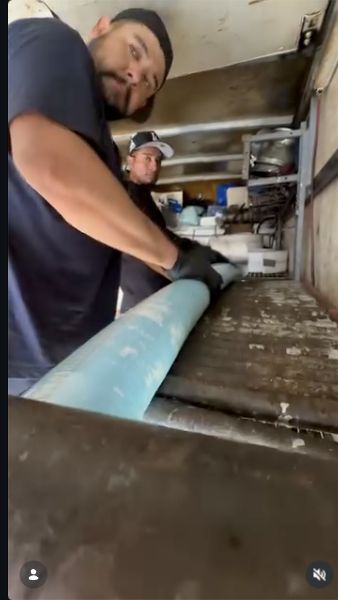
Open embedded Instagram video
Watch the original Pasadena project on Instagram ↗
What this means for your property
If your sewer backs up repeatedly, understanding the pipe condition comes before choosing another cleaning or repair. A sewer camera inspection can help identify visible conditions and guide the next step. Hydro jetting addresses buildup in suitable lines; it does not repair a broken pipe.
Explore our CIPP sewer lining and trenchless sewer repair services to compare the approaches. Your estimate depends on access, preparation, pipe condition and the section requiring work.
Planning sewer work in Pasadena?
Tell us your address, symptoms and any previous inspection findings. Our La Verne-based office can confirm service availability and discuss an assessment for your property.
Pasadena sewer lining: 5 essential planning questions
This Pasadena sewer lining case study documents one 44-foot cast-iron project. It is useful as an example of the method and work shown in the original footage, while another property’s scope still needs assessment. Use the project to prepare questions about findings, access and completed work rather than assuming it establishes a price, timeline or repair choice for your line.
1. What condition supports the proposed method?
When discussing Pasadena sewer lining for your property, ask which observed condition the recommendation addresses. Keep available footage and findings with the proposal. A method shown on another project does not establish suitability for every pipe. Ask the provider to explain what is known about the section being considered and which questions remain before the work is selected.
2. Which section would be included?
The documented 44-foot length belongs to this Pasadena sewer lining project. For another estimate, ask for the intended start and end of the proposed work and how those boundaries were established. Clarify how the recommendation relates to the affected fixtures and the route assessed. Keep exclusions visible so a proposal for one section is not mistaken for rehabilitation of the entire system.
3. What preparation and access are needed?
Ask how the existing line would be prepared and which access locations are required. A Pasadena sewer lining proposal should explain its own site conditions rather than borrowing the access arrangement from this example. Confirm who handles any opening, protection, preparation and restoration. Ask how additional findings would be discussed if the planned access or scope needs review.
4. How will the finished work be checked?
Request an explanation of the completion checks and available records for the actual scope. Keep the completed section, any footage provided and applicable care information together. A Pasadena sewer lining record should describe what was installed and any limitations that remain without implying that unrelated portions of the line were repaired or evaluated.
5. What should remain in the property file?
Save the findings, estimate, approved changes and completed-work description. Identify recommendations still under consideration separately from work performed. If a symptom later changes, share the new observation alongside those records. The original Pasadena sewer lining footage is part of this case study’s documentation; it should not be treated as footage of another property’s system.
Discuss your own property’s findings
Tell SoCal Rooter the address, affected fixtures, recurrence history and available inspection records when requesting an assessment. The office can confirm service availability and discuss the next step. Pasadena sewer lining questions are most useful when they connect the observed condition, proposed section and practical access needs. The project example illustrates an approach; the recommendation for your line should be explained against its own findings.
Your property’s next step
Find out what your sewer needs.
Describe the problem to our team. We explain suitable options and discuss the estimate before work begins.
Online requests require office confirmation.
Plan the details before work begins
Open the topics that apply to your property. These planning notes help you discuss the work, compare the scope and prepare for the next step.
A homeowner’s guide to using this project example
The guidance below is for homeowners considering their own assessment. It adds planning questions, not additional claims about the documented job. The Pasadena sewer lining example remains the 44-foot cast-iron project shown above. Another property’s condition, repair boundary and access must be established from its own findings.
Begin by separating the example from your current concern. The video shows work on one line, while your request may involve recurring backups, a recent inspection or a different symptom. Describe that concern first. A method demonstrated successfully in a project record does not by itself establish suitability elsewhere.
Use the case study to recognize the decisions a proposal should explain: the condition addressed, the selected section and the preparation needed. Those are useful comparison questions even when another property’s eventual repair differs. The goal is understanding the recommendation, rather than matching the dimensions or arrangement of this example.
A Pasadena sewer lining conversation should leave the homeowner able to identify the proposed objective in ordinary language. Ask the provider to explain unfamiliar terms against the actual line. Technical wording can describe the method, but it should not replace a clear account of what the work is intended to address.
For Pasadena sewer lining research, distinguish a documented job fact from a planning question. The example identifies its own material, length and method. Questions about another property should stay framed as questions until an assessment supports the answer, rather than borrowing certainty from a successful installation elsewhere.
Bring evidence that belongs to your own line
Gather the relevant inspection record, symptom dates and actual completed repair history. Keep an earlier estimate labeled as proposed work if it was never performed. This prevents the current assessment from assuming a particular section was replaced or checked simply because it appeared in an old document.
Identify which observations are current. A recent backup, an older mark and a remembered plumbing conversation are different kinds of information. Each can be retained with its date and source. A clear history lets the provider ask focused questions without treating every item as evidence of one confirmed condition.
If footage is available, ask for the relevant section and finding to be explained. A homeowner should not have to diagnose an image independently. Keep any viewing limitation with the record so a partial assessment is not later described as a complete condition report for the whole connected system.
The original Pasadena sewer lining footage belongs to this case study. It should remain separate from the records for your property. Your assessment needs its own address, observed condition and scope explanation, even if the existing material or general symptom appears similar to what prompted interest in the example.
Keep owner observations separate from a professional finding. A backup date can explain why you are asking about Pasadena sewer lining, while an inspection helps establish the relevant condition. Both belong in the discussion, but neither should be silently rewritten to make the history appear more conclusive than it is.
Compare repair boundaries before comparing lengths
The documented length is a project fact, not a template. For your proposal, ask where the repair would start and end and why those boundaries are recommended. A shorter or longer section may serve a different objective. Length alone does not establish whether two scopes address the same condition.
Ask what lies outside the proposed work. Nearby pipe, connected branches or another reported concern should not be assumed included merely because they are part of the same property. A Pasadena sewer lining estimate should make the actual boundary understandable enough that the completion record can later be compared with it.
If further preparation is needed to clarify the view, ask how that affects the initial proposal. The boundary may need review after more information becomes available. Keep that uncertainty visible instead of treating an early discussion as a finalized scope supported by findings that have not yet been obtained.
When alternatives are discussed, compare them against the same evidence and objective. Rehabilitation and replacement are different approaches. The provider should explain what each would address and what remains unresolved, rather than expect the homeowner to choose solely from a preferred method name or an unrelated project photograph.
A Pasadena sewer lining comparison is easier when each estimate describes the same categories. List the condition, boundary, preparation, access and verification. Mark a missing item as unclear and ask the provider about it instead of assuming that similar method names mean every part of the proposed work is equivalent.
Plan preparation and access as separate questions
Ask what preparation the proposed system requires and how it is included in the scope. A prior cleaning appointment may have had a different purpose. The relevant professional should explain the relationship between that earlier work and the readiness requirements for the actual repair being considered at your property.
Access should be described for the site where work is proposed. Do not assume that another Pasadena sewer lining project will use the same arrangement as the example above. Explain known gates, occupied areas and access restrictions, then ask which areas are needed and what work may affect them.
Clarify the expected handoff for opened areas. Access closure and decorative restoration can be different tasks, with another provider responsible for part of the work. Ask which endpoint is included and who coordinates anything outside the plumbing scope, so the overall project has a clear next step.
If preparation reveals a different condition, ask how the finding will be documented and reviewed. A clear plan identifies the decision-maker and the proposed revision. Retain the updated explanation with the original estimate rather than letting the first scope remain the only record of a changed final project.
Coordinate an occupied home without assuming a standard schedule
A project video is not a scheduling promise. Ask for the sequence relevant to the proposed work, including preparation, installation and the release for fixture use. Pasadena sewer lining planning should reflect the selected system and actual property conditions rather than a duration inferred from edited footage or another installation.
Tell the provider about occupants, tenants and any room that is difficult to make available. Identify who arranges entry and who approves additional scope. Those roles may belong to different people. Clear contacts prevent an occupant from being unexpectedly asked to authorize work outside their agreed responsibility.
Ask which fixtures must remain unused and how everyone will receive an updated instruction. Nearby fixtures should not be assumed to have identical restrictions because of their location. The actual work plan should guide the message, and the person coordinating the property should know who confirms when use resumes.
If the sequence changes, keep the practical update separate from the technical record but consistent with it. Occupants need to know what action affects them, while the authorized contact may need the fuller scope explanation. Both should receive current information rather than different versions of the original appointment plan.
For a managed property, keep the authorized decision contact available during the appointment. A Pasadena sewer lining assessment may produce a question requiring further review. The person supplying entry should not be expected to approve a revised scope unless that responsibility has been clearly arranged in advance.
Read completion records within their actual limits
For your project, ask what identifies the completed section and how the work was checked. A Pasadena sewer lining record should describe the actual scope and any limitation remaining outside it. It should not imply that every unrelated part of the property’s plumbing was also repaired or fully assessed.
Keep the final approved scope with any supplied footage, notes and care information. An earlier proposal may differ from the work ultimately completed. Retain both with their status clear, so another provider or future property contact can understand the decision sequence without assuming every alternative discussed was installed.
Review warranty information in its supplied form and ask the relevant provider to clarify terms. A general product statement is not the same as the coverage for a particular installation. Do not combine separate documents into a broader assurance or infer terms from the fact that another project used a similar method.
If a later symptom appears, make a new dated observation and compare it with the completed boundary. A Pasadena sewer lining project record can support the discussion, while the current assessment establishes the relationship. Similar symptoms do not automatically prove that the new concern is within the earlier repaired section.
Store records by address and date when managing more than one property. A Pasadena sewer lining file should identify the actual completed section and any pending recommendation, so a later contact does not confuse the project with another installation or mistake proposed work for work that was performed.
Prepare a focused Pasadena sewer lining assessment request
Start your request with the address, affected fixtures and present symptoms. Add the recurrence pattern and relevant previous findings. If the route or repair history is uncertain, state that honestly. A concise factual account is more useful than requesting a specific hidden repair based only on the example shown here.
The office can confirm availability for your actual address. Interest in Pasadena sewer lining does not replace that scheduling conversation or establish that the same access, method or scope will apply. Explain any property coordination needs early so the assessment can be discussed around the conditions actually available.
Keep three questions ready: what finding supports the recommendation, which section would be treated and what remains outside the proposal? These questions help connect the method to your property. They also make it easier to compare offers that may use similar language while describing different stages, boundaries or restoration endpoints.
Before proceeding, summarize your understanding and ask the provider to correct any mismatch. You should be able to describe the objective and important limitation without becoming a lining specialist. A clear Pasadena sewer lining discussion turns the project example into useful preparation while leaving the actual recommendation grounded in your own findings.
Online requests require office confirmation. Share meaningful changes in the current condition while an appointment is being arranged. The case study preserves the original job’s documented facts; the next step for another property is an assessment that explains its own condition, proposed work and practical handoff.