
Pasadena sewer lining: 44 feet of cast-iron pipe
Follow our Pasadena CIPP project with a field photo, original project video and an explanation of the lining work.
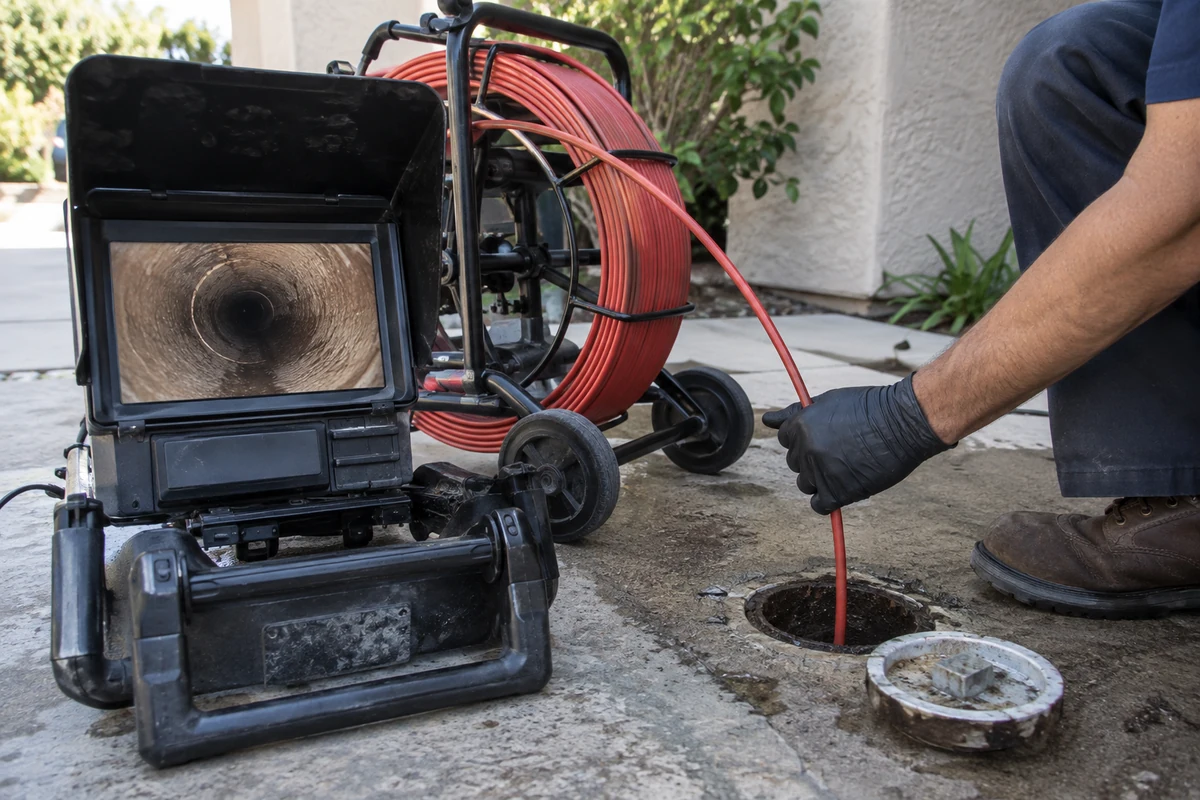
Get a clearer picture of what is happening underground with a sewer camera inspection.
THE RIGHT APPROACH
Slow drains and recurring backups can have different causes. A sewer camera inspection helps locate visible buildup, root intrusion and pipe defects inside accessible sewer lines. The findings help us explain the next steps and scope the work before a repair begins. After a sewer camera inspection, we walk you through what the camera showed. A follow-up sewer camera inspection can also confirm the result after cleaning or repair.
SoCal Rooter & HydroJet is based in La Verne and serves nearby communities including San Dimas, Claremont, Pomona, Glendora and Upland. Check the complete service area and contact our team to confirm availability at your address.
When you call, describe the issue, the fixtures affected and any earlier inspection or repair. We review the conditions, explain suitable options and discuss the estimate before work proceeds. Online requests require office confirmation.
WHAT TO EXPECT
An inspection identifies visible conditions. Cleaning or repair is a separate service recommended from the findings.
Ask our team to document the inspection and the work performed for your project.
A sewer camera can show visible conditions inside an accessible line, including buildup, roots and pipe defects. Heavy blockage or limited access can restrict the view, so cleaning may be needed before the line can be fully assessed.
Share which fixtures back up, how often it happens, any previous repairs or inspection reports, and the location of a known cleanout. This helps the team plan access and understand the problem.
Yes, you can discuss an inspection when planning a purchase or renovation, subject to access and scheduling. Arrange permission to enter the property and ask whether an accessible sewer cleanout is known. Share previous reports and the areas you plan to remodel so the purpose of the inspection is clear. A sewer camera examines the accessible line interior; it does not provide a complete assessment of every water supply pipe, fixture or water heater. Ask which sections the proposed inspection covers and what documentation is available. Coordinate any decision deadlines before booking, since an online request still requires office confirmation.
An incomplete view should be identified as a limitation, rather than treated as proof that the unseen pipe is sound. A blockage, limited access or another obstruction may prevent the camera from reaching the intended section. Ask where the inspection stopped, what was visible and which questions remain unanswered. The next step may involve cleaning, a different access point or a separate assessment, depending on conditions. Have the technician explain that additional scope before authorizing it. When comparing repair recommendations, distinguish a defect that was observed from a suspected problem that still needs investigation, especially if a large replacement is being considered.
Start with the location and type of condition the camera showed, then ask how each proposed option addresses it. A localized defect, widespread deterioration and removable buildup can lead to different recommendations. Ask the team to explain the relevant footage or images in plain language and to identify the section included in the proposed work. Request available documentation of the findings, along with any uncertainty about portions that could not be inspected. Keep those records for later work or a second assessment. Camera images are most useful when paired with an explanation of access, repair boundaries and any further investigation needed.
PROJECT DETAILS FROM OUR CREW
Follow our Pasadena CIPP project with a field photo, original project video and an explanation of the lining work.
See how descaling and hydro jetting prepared a restaurant sewer for four CIPP liners installed through one access point. View the project photo, video and scope.
Each project reflects its own pipe condition and access. Request an assessment for your property.
Open the topics that apply to your property. These planning notes help you discuss the work, compare the scope and prepare for the next step.
An inspection is most useful when the reason for it is understood before the visit. You may be investigating repeated backups, reviewing a reported defect or planning work on a defined section. Explain which decision the information will support. A general request to look at the sewer can leave different expectations about coverage, documentation and the relationship between the inspection and any later cleaning or repair.
Describe the symptoms without deciding what the camera must find. Identify affected fixtures, when the concern occurs and whether previous service changed the pattern. A sewer camera inspection can inform the next step, but the initial household report should remain an observation rather than a diagnosis of hidden piping. This gives the technician useful context without narrowing the assessment around an unsupported assumption.
If the request relates to a purchase or renovation, state that purpose and the requested timing. Arrange authorized access and confirm what the proposed visit covers. The inspection of an accessible sewer section is not a complete assessment of every water supply line, fixture or heater. Keep the technical findings within their scope and use the other professional input appropriate to the wider project or property decision.
For a La Verne-area property, share the address, relevant history and the question you want answered when contacting SoCal Rooter. The office can discuss a sewer camera inspection appointment and availability. You do not need to interpret earlier footage independently before asking for help, but providing the original recording and explanation can make the discussion more focused than a selected screenshot alone.
Tell the office about known access locations, locked areas and any shared space that requires another contact. Describe what you know without opening caps, removing heavy covers or exposing pipe yourself. The contractor should establish the appropriate access for the proposed work. A practical description can support planning while leaving technical preparation and assessment of the actual entry point to the responsible professional.
Keep earlier invoices and inspection documents with their dates and scope descriptions. A sewer camera inspection record from before a repair should not be mistaken for a later completion record. If the relationship between files is unclear, label that uncertainty. The technician can ask for clarification rather than inheriting an inaccurate history that suggests a section was already evaluated or treated when the documents do not establish that.
Report any cleaning products or other attempts already used to address the concern. Do not add another treatment or keep running affected fixtures to demonstrate an active backup. Explain the current condition and what happened previously in plain language. The aim is to provide useful existing information, not to create more discharge or change the system before the assessment in an effort to make the problem easier to observe.
Identify who will provide entry and who can discuss a changed scope. At a managed property, those roles may be separate. Share the symptom notes with the person on site and keep the authorized contact reachable. A sewer camera inspection can raise a follow-up question, so the communication plan should allow that question to be explained without treating ordinary access permission as approval for additional work.
Ask where the inspection began, which route was evaluated and whether the intended endpoint was reached. Keep the explanation in terms you can relate to the record. Do not assume a video title such as main sewer means every branch was included. A clear coverage description helps you understand both the findings and the areas that remain outside the work rather than relying on a broad service label.
Camera travel and visibility are different questions. The device may move through a section while water or another condition limits what can be seen. A sewer camera inspection explanation should identify that distinction. An obscured area is neither proof that the pipe is sound nor proof of a particular defect; it is a limitation to consider when deciding what further information is needed.
If the camera cannot proceed, ask what was visible up to that point and what stopped the evaluation. Keep a suspected cause distinct from a confirmed finding. The next step should address the actual limitation rather than assume every incomplete inspection requires the same response. Our incomplete-inspection guide offers questions for discussing a defined follow-up assessment.
Request an explanation when a location or distance is unclear. A homeowner should not need to map underground piping from a number shown on a screen. The professional can describe how the observation relates to the documented route. This makes a sewer camera inspection more useful for later decisions while avoiding a false sense of precision about boundaries that were not actually established during the visit.
Ask which available images or recording show the condition being discussed and retain the accompanying explanation. A dramatic still image may illustrate one point without showing its full context. Keep the complete available record where practical. This helps a later professional review the relevant section and its limitations instead of receiving only the moment a homeowner found most concerning without the surrounding inspection information.
Label the sewer camera inspection date separately from the date a file was emailed or downloaded. Recently received footage can still describe an older condition. Record whether work occurred afterward and whether the present symptom differs from the original complaint. These details prevent a historical recording from being treated as a current guarantee or as proof of the cause of every later drainage event at the property.
Separate what was observed from what was recommended. A report may identify a visible condition, explain uncertainty and propose a next step. Those are related statements, but they are not interchangeable. Retain the original wording and ask for clarification where needed rather than rewriting a possible explanation into a definite fault or treating a recommendation as evidence that the work was already completed.
If another assessment is requested, share the available original record and your specific question. Explain any intervening cleaning or repair. A sewer camera inspection comparison is more meaningful when both professionals are considering the same evidence and current history. Different conclusions should be explained through the findings and limits rather than assumed to reflect the same information merely because both refer to the sewer.
Cleaning may be discussed when a condition affects flow or limits evaluation, but its purpose should be stated. Ask which section is included and what result the task is expected to achieve. Removing material, improving a view and repairing an identified defect are different objectives. A useful plan keeps those stages distinct instead of describing every activity as though it provides the same information or completes the same repair.
If cleaning is proposed before another sewer camera inspection, ask what is expected to become clearer afterward. The answer should connect preparation to a specific unanswered question. Do not assume that repeating the recording automatically resolves every uncertainty. The professional should explain what can reasonably be evaluated after the proposed step and which limitation may still remain because of access or the actual pipe condition.
Restored flow is a useful result, but it does not by itself describe the full condition of the line. Ask what the service established and whether any further assessment has a defined purpose. This avoids two unhelpful assumptions: that every cleared blockage needs extensive work, or that water draining again proves there can be no other concern. The next decision should follow the findings at the property.
Review the drain cleaning and hydro jetting information when those services are discussed alongside a sewer camera inspection. Ask why a particular method fits the assessed condition and what is excluded. You can understand the proposed sequence without choosing equipment based solely on a method's name or assuming that one approach is appropriate for every line.
A repair recommendation should identify the condition it addresses and the proposed section. Ask how the boundary relates to the available evidence and whether surrounding pipe was evaluated clearly. A local repair and a longer replacement may serve different objectives. The length or price alone does not explain suitability, so request the reasoning behind each option before treating them as equivalent projects.
Keep uncertainty about unseen sections visible in the proposal. A sewer camera inspection that stopped early should not be summarized as a complete evaluation of the entire route. Equally, limited visibility does not by itself prove every unobserved section requires replacement. Ask what further assessment would clarify the question and how the result could affect the repair decision being considered.
Compare access, preparation, connections and restoration as well as the underground repair. Two proposals can describe a similar section while including different supporting work. Each provider should explain their own scope and exclusions. Do not fill a gap in one quote with an inclusion from another. A complete comparison makes the practical impact understandable while keeping the repair connected to its stated purpose.
If new information changes the recommendation, retain the explanation and approved revision with the original record. This preserves how the decision developed after the sewer camera inspection instead of making the final scope appear to have been known from the start. Our repair-boundary guide provides related questions for comparing a limited section with a broader proposal.
Before the visit closes, ask what is known, what remains uncertain and what action is recommended for a stated reason. Keep those categories separate. A follow-up suggestion should not be recorded as completed work, and an incomplete view should not disappear from the summary. This creates a useful handover whether the next step is another assessment, a service proposal or simply retaining the findings for future reference.
Store the sewer camera inspection record with the service address, date, relevant scope and any later work. If access is supplied through an online link, keep enough information to identify the file and its provider. A useful property history should let another authorized contact understand which recording belongs to which stage without guessing from filenames or relying on the memory of the person who attended.
If symptoms change later, describe the new location and timing before assuming the earlier explanation still applies. Share the relevant history and say what occurred since the inspection. A current concern may relate to the same section or a different issue. The records support the next evaluation, but they should not be treated as a permanent diagnosis of every future drainage problem.
SoCal Rooter's project examples show how inspection, preparation and repair can relate within particular jobs. They do not establish the condition or scope of your property. When requesting a sewer camera inspection, bring the current concern and available history into the conversation. The assessment should provide an explained record of what could actually be evaluated and a practical basis for the next decision.
YOUR NEXT STEP STARTS HERE.
Ask us about service or scheduling. For urgent issues, call 909-969-1838.